





By Teresa J. Reasor
According to Ansen Dibell in his book, Plot, How to build short stories and novels that don’t sag, fizzle, or trail off in scraps of frustrated revision-and how to rescue stories that do., plot is a verb. The struggle a writer goes through to hew his plot is certainly worthy of verbal recognition. And the story itself should be as well.
The important points in your story are the Hook, the inciting incident that starts the ball rolling, and the Climax, the moment in your story where the bad has become as bad as it can get. The climax should be the point where the heroine/hero prove themselves worthy of their heroine/hero status. Everything between these two points, the hook and the climax, should build from one to the other.
Most of us are familiar with the Story Arc that some plots follow. This structure divides a plot into increments between the Hook and the Climax in this manner:
1. Hook, Call to Action
2. Choice, Bad Things Happen
3. Gray Moment
4. Black Moment-Crisis
5. Climax
6. Resolution
The above structure is based loosely on The Hero’s Journey by Christopher Vogler which is:
1. Ordinary world
2. Call to Adventure
3. Refusal of the Call
4. Meeting the Mentor
5. Crossing the First Threshold
6. Tests, Allies, Enemies
7. Approach to the inmost Cave
8. Ordeal
9. Reward (Seize the Sword)
10. The Road Back
11. Resurrection
12. Return with the Elixir
I much prefer the Stairway to Suspense structure which is:
1st step: The hook (the Call to Action.)
2nd step: The decision or choice the heroine/hero makes that turns the story in the direction it will travel. This choice is based on some character flaw that guides the character’s motivation for the choice.
3rd step: The choice creates obstacles to solving the situation.
4th step: The character makes another choice which causes more problems and the situation worsens.
5th step: The more choices a character makes the more obstacles will be thrown into his/her path.
6th step: The climax where the greatest obstacles and the greatest attempts must be made to overcome the situation created in the hook.
7th step: The resolution, which is short, sweet, and should tie up all the loose ends and leave the reader feeling completely satisfied.
During the building from Hook to Climax, the plot should be firmly held in the writer’s mind and everything that happens should be working toward that climatic point of discovery, self-understanding, or solution, or all three.
There are many structures a writer may use to create his/her plot.
The Linear Plot structure is one that moves from the inciting incident (Hook) through a sequence of events to the climax in a seemingly straight line. Sound boring? It shouldn’t be if we do our job as writers. In a linear plot the main plot takes precedence over other things in the story. Between the hook and the climax you can have as many subplots, twists, and turns as your story needs or will allow. But by the moment of climax the subplots should be tied off leaving the hero and heroine to bond together and face the climax together. Most contemporary romances and romantic suspense follow this kind of plot structure.
In a Braided Plot there is a main plot that threads its way through the entire story, but plot lines that move out away from the main plot then fold back in tying the entire story into a cohesive whole. Each plot line that breaks away from the main plot can be an opportunity for the writer to introduce and build a story line for a character. For example: Your story is about three sisters who travel out to Los Angeles seeking fame, fortune, and love. One meets a producer who falls in love with her and puts her in a movie, one meets an architect who seems to be the answer to all her dreams, and one meets a drug dealer who snows her and gets her hooked on cocaine. Say the drug-dealer boyfriend is murdered and all the evidence points to the sister who loved him. The murder may be the main plot, but each sister will have her own point of view, her own story, her own struggles, her own risks she must take, and things she may loose by being involved in the main plot. Each strand must dovetail and loop around the main plot to tie the whole structure together. By the climax of the story all three sisters will have bound together to solve the crime and face the bad guy.
In the Circular Plot structure the Hook and the Climax are bound together by an intimate set of characters, an object, or a location. For example: In my own manuscript, Captive Hearts, the hero, Matthew Hamilton, has been imprisoned unjustly for smuggling. By the Black Moment of the story, he is once again imprisoned, this time for murder. The book begins in the prison and the Black Moment takes us back to that same location.
Most circular plot lines have a conclusion that is quiet and introspective. In the case of Captive Hearts, the villain, Garrett Blake watches the hero and heroine, sail away to America, and thinks, though he has nearly been captured, he will live to fight another day. When he turns to leave the dock he discovers a group of English soldiers waiting to arrest him. Who says quiet has to be boring or without action. (This character and ending were edited from the story before publication.) Captive Hearts, 2007.
A Parallel Plot is where two different plots are traveling through the story at the same time. These two plot lines may mirror each other in terms of action or events, though the characters in each may be totally different. For example: In my manuscript Timeless, a reincarnation/parallel universe story, my heroine in the past, Coira, dies underwater. My heroine in the present, Regan, is a marine archeologist who is studying the monoliths underwater. Coira is a druid priestess who runs afoul of the village priest. Regan runs afoul of someone on the dig. Coira is kidnapped by the priest and his followers. Regan is hunted by the bad guy (can’t tell you, who it’s a spoiler). The two plot lines converge when Regan has to fight off the present day bad guys at the same time Coira is fighting off the bad guy of the past, in the same room. The plot strands become parallel again when Regan is reunited with her lover and Coira is reunited with her husband.
In parallel plot lines, in order for the pacing to be kept quick, the chapters should be kept short, the point of views structured so that there is no confusion about who is speaking or thinking in each chapter, and the points of action in each plot should be strongly established, but mirror each other sometimes. And there has to be some points of convergence between the story lines that tie them together.
A word of caution about the mirroring technique. I’ve explained mirroring in my own plot very broadly, but though similar events happen, they have to be written in a dissimilar fashion in order to add variety to the plot and keep it interesting. Mirroring should be done in such a subtle manner that the reader doesn’t realize that’s what you’re doing.
The most current example of this I can think of is the Disney movie Finding Nemo, produced by Pixar Studios. At the beginning of the film, father Marlin and son Nemo are together. Catastrophe happens and they are separated. Marlin meets Dory, who becomes his support network, Nemo meets all the fish in the fish tank, who become his support network. Marlin risks his life to save Dory from a run in with jelly fish, Nemo risks his life in the tank filter to try and free himself and the other fish. The events mirror one another, but are totally different. At the conclusion of the film, father and son find each other and bond together to save Dory and their parallel plots have merged to end the story.
These Plotting structures and methods are by no means the only ones available to writers, but some of the best I have found. Like everything else in writing, there are a myriad number of techniques to use in plotting and an unlimited number of scenarios to write about. Those can only be limited by a writer’s imagination. Your imagination is perhaps the most important plotting device, so use it well.
Ansen Dibell, Plot, How to build short stories and novels that don’t sag, fizzle, or trail off in scraps of frustrated revision-and how to rescue stories that do., 1988, Writer’s Digest Books.
Teresa Reasor, Captive Hearts, 2007, The Wild Rose Press.
Christopher Vogler, The Writer’s Journey, 1998, Michael Wiese Productions.
Robert Kernen, Building Better Plots, 1999, Writer’s Digest Books.
Walt Disney, Finding Nemo, Produced by Pixar Studios, 2004.
Teresa Reasor, Timeless, Work In Progress, 2008.
Friday, February 27, 2009
Wednesday, February 25, 2009
ANYA BAST is Our Special Guest Today

Hi all – Thanks so much to Inspiration, Ink for inviting me to guest blog today!
My name is Anya Bast and I'm the author of over twenty five published works of fiction, most of them paranormal and most of them scorching hot. I write for Berkley Sensation, Harlequin Spice and Samhain, among other houses.
Today I thought I'd talk about that critical first line. I love writing that very first line of a novel. Actually, I obsess over them, rewriting them several times before I end up with the final version.
The first line is the first impression the reader gets of your work while they're standing in the bookstore deciding whether or not to buy your book. It's pretty important! It needs to hook the reader and make them want to read on. Your objective is to intrigue the reader, make them wonder what's going on and why.
If you can accomplish that much, then it's your job in the next few paragraphs to dig that hook in a bit deeper and add a dash of emotion, make the reader care about one of characters enough to invest even further.
Here is a sampling of some of the first lines from my books…
1. He looked like sin and seemed like salvation. Salvation for her sluggish libido, anyway. (Witch Fire, June 5, 2007 — Berkley Sensation)
2. How to Catch a Warlock 101. Isabelle could teach that class. (Witch Blood, March 4, 2008 — Berkley Sensation)
3. Twenty years as a daaeman's handmaiden had prepared Claire for many things, but not this. Nothing could've prepared her for this. (Witch Heart, January 6, 2009 – Berkley Sensation)
4. Sarafina might've been named for the angels, but she'd always known one day she'd end up in hell. (Witch Fury, June 2, 2009 – Berkley Sensation)
5. Alejandro leaned against the bar and watched the crush of dancers gyrate to the pounding beat in the Blood Spot. Lights flashed through the dark interior of the building, periodically illuminating bodies clad in almost nothing. (The Darkest Kiss, October 2008 — Berkley Heat)
6. The brown-haired businessman beside Cassidy at the roulette wheel held up a chip. “Kiss it for luck?” He gave her smarmy grin and a slow head-to-toe perusal. (The Deal, What Happens in Vegas…. May 2008 — Harlequin Spice)
I guess the reason I feel so strongly about my own first lines is because that's usually how I judge whether or not I'll buy someone else's book. My purchasing test goes something like this if the name on the spine is someone unfamiliar to me:
- Cover art…yeah, I'm shallow. ;) A good cover will get me to investigate a book further. Doesn't mean I'll buy it, just give it a closer look.
- Back blurb – Does it sound like "my kind" of book? My kind of book invariably being something of the paranormal or fantastical nature.
- First line – Does it catch me?
If the book passes all those tests, I skim the first page. If that looks good…GLOM. It's mine. *g*
How about you? What are your buying criteria when you encounter an intriguing book at the bookstore by an author you've never heard of? Some people pay attention to the cover quotes, others have a complicated test of flipping through the book at every forty pages or so and reading.
And how about those first lines?
And how about those first lines?
If you're an author, I invite you to share some of your opening gambits in the comments. If you're a reader, what's your buying criteria and do first lines figure into them? Got any fav first lines you'd like to share from anything you've read lately?
I'll give away an autographed copy of my latest release, Witch Heart, to one commenter.

WITCH HEART
Available NOW from
Berkley Publishing
ISBN-10: 0425225534
ISBN-13: 978-0425225530
ISBN-13: 978-0425225530
Monday, February 23, 2009
Hero Archetype: The Charmer
The Charmer
The Charmer is the ultimate playboy, irresistible and unreliable, the guy who can’t commit. He is sexy and charismatic. He’s the man whose heart-melting smile and charm have you fanning your over-heated face. Hard work is not his mantra, and he tries to get by on his looks and sense of humor. He believes he can talk his way out of anything. He knows how to play people. His parents and friends are just as enthralled with him as he is with himself. Charmers are the life of the parties and appear to have their life together. People are attracted to charmers and are easily persuaded to their viewpoints. Charmers tend to run away if the conversation turns to anything with emotional depth, and they rarely show their true feelings.
 In Failure to Launch, MATTHEW MCCONAUGHEY plays a thirty-five year old who enjoys rock climbing and surfing and suffers from a fear of intimacy. He also happens to live with his parents. He uses them to protect him from developing serious relationships. He always seems to be clever enough to stay ahead of the women he dates. When he realizes they’re getting serious, he breaks the news that he’s not interested in a permanent relationship with anyone. He’s a boat salesman; a perfect occupation for a charmer where a smile can make him a fortune without hard work. He can sell anything, and his customers walk away believing they made the perfect purchase.
 JAMES GARNER played Bret Maverick, TV's most reluctant hero. He’d rather talk his way out of trouble by buying a fella a drink, or offering up a cigar. He played his cards close to his chest and always seemed to know the cards in the other guy’s hand. Not a cheater but not afraid to bend the rules either. He was a keeper of secrets with the ability to bluff his way through the worst of situations. While not a fighter by nature, he was never afraid to fight if there was no other way. Afterwards, he’d dust off his jacket, resettle his hat, and walk away the winner. Too often, though, he found himself rescuing a damsel in distress. Gambler by trade, Maverick travelled the West in search of good times and the easy way.
LEONARDO DICAPRIO as Jack Dawson, a devil-may-care artist in the Titanic, is a perfect example of a Charmer. He’s a free spirit and knows how to have a good time. After winning two tickets in a poker game he boards the doomed ship moments before it sails. Rose finds his carefree life alluring. She’s a deeply romantic dreamer and Jack’s life represents freedom and all that she’s never had the courage to live; as seen in the following dialogue from the movie.
 Rose: “Teach me to ride like a man.”
Jack: “And chew tobacco like a man.”
Rose: “And spit like a man.”
Jack: “What they didn’t teach you at finishing school?”
 CARY GRANT was the quintessential handsome charmer who often played the role of wealthy, privileged man who never had to work to maintain his hedonistic lifestyle. He had technique and charm. He was the suave-about-town man who could punctuate a joke with the lift of his brow. He was quick-witted and won the hearts of women without trying. He was not a womanizer, but he loved women. He was a man of natural intelligence and style who could wear a tux better than any man in Hollywood.
Who’s your favorite charmer? It might be a character in a movie or a book, or a real-life guy who has charmed the beegeebees out of you! Give us a shout back and let us know.
Happy Reading!
Posted By: Katherine Lowry Logan
The Charmer is the ultimate playboy, irresistible and unreliable, the guy who can’t commit. He is sexy and charismatic. He’s the man whose heart-melting smile and charm have you fanning your over-heated face. Hard work is not his mantra, and he tries to get by on his looks and sense of humor. He believes he can talk his way out of anything. He knows how to play people. His parents and friends are just as enthralled with him as he is with himself. Charmers are the life of the parties and appear to have their life together. People are attracted to charmers and are easily persuaded to their viewpoints. Charmers tend to run away if the conversation turns to anything with emotional depth, and they rarely show their true feelings.
 In Failure to Launch, MATTHEW MCCONAUGHEY plays a thirty-five year old who enjoys rock climbing and surfing and suffers from a fear of intimacy. He also happens to live with his parents. He uses them to protect him from developing serious relationships. He always seems to be clever enough to stay ahead of the women he dates. When he realizes they’re getting serious, he breaks the news that he’s not interested in a permanent relationship with anyone. He’s a boat salesman; a perfect occupation for a charmer where a smile can make him a fortune without hard work. He can sell anything, and his customers walk away believing they made the perfect purchase.
 JAMES GARNER played Bret Maverick, TV's most reluctant hero. He’d rather talk his way out of trouble by buying a fella a drink, or offering up a cigar. He played his cards close to his chest and always seemed to know the cards in the other guy’s hand. Not a cheater but not afraid to bend the rules either. He was a keeper of secrets with the ability to bluff his way through the worst of situations. While not a fighter by nature, he was never afraid to fight if there was no other way. Afterwards, he’d dust off his jacket, resettle his hat, and walk away the winner. Too often, though, he found himself rescuing a damsel in distress. Gambler by trade, Maverick travelled the West in search of good times and the easy way.
LEONARDO DICAPRIO as Jack Dawson, a devil-may-care artist in the Titanic, is a perfect example of a Charmer. He’s a free spirit and knows how to have a good time. After winning two tickets in a poker game he boards the doomed ship moments before it sails. Rose finds his carefree life alluring. She’s a deeply romantic dreamer and Jack’s life represents freedom and all that she’s never had the courage to live; as seen in the following dialogue from the movie.
 Rose: “Teach me to ride like a man.”
Jack: “And chew tobacco like a man.”
Rose: “And spit like a man.”
Jack: “What they didn’t teach you at finishing school?”
How could Rose possibly resist his charm?
 CARY GRANT was the quintessential handsome charmer who often played the role of wealthy, privileged man who never had to work to maintain his hedonistic lifestyle. He had technique and charm. He was the suave-about-town man who could punctuate a joke with the lift of his brow. He was quick-witted and won the hearts of women without trying. He was not a womanizer, but he loved women. He was a man of natural intelligence and style who could wear a tux better than any man in Hollywood.
Who’s your favorite charmer? It might be a character in a movie or a book, or a real-life guy who has charmed the beegeebees out of you! Give us a shout back and let us know.
Happy Reading!
Posted By: Katherine Lowry Logan
Thursday, February 19, 2009
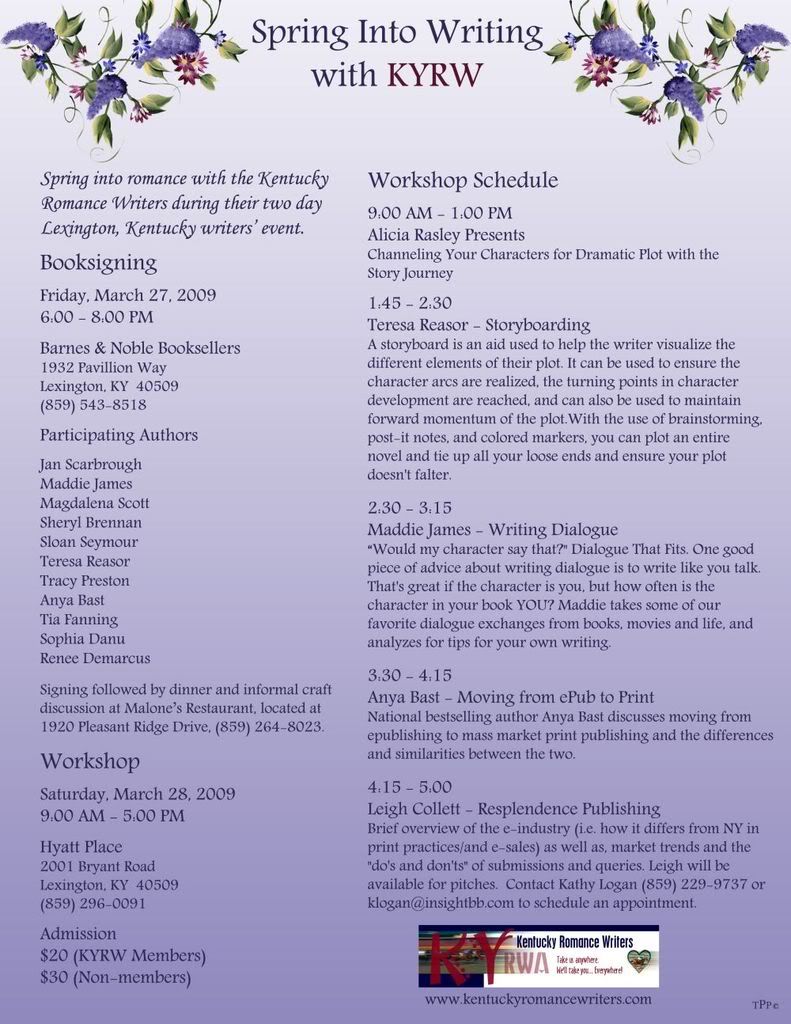
KYRW Writing Workshop

Spring Into Writing With KYRW!
Have you ever wondered just what goes on behind the closed doors of an RWA chapter meeting? Or maybe you're entertaining the idea of writing a romance yourself (believe me, it's not as easy as it sounds). Or still yet, maybe you've finished that manuscript, and you're looking to fine tune it, but could use a few pointers. This workshop could give you the very answers you've been looking for!
Just to name a few, we've scheduled Alicia Rasley as our featured guest-speaker, and she'll be presenting a workshop on Channeling Your Characters for Dramatic Plot through the Story Journey. Best-selling paranormal author Anya Bast will also be in attendance, presenting a workshop on moving from epub to NY print. We'll also have Leigh Collett, Resplendence Publishing's CEO -- and she'll be taking pitches, so call or email Kathy Logan to set up your appointment ASAP!
What more could you ask for from a writers' event when we've recruited our very own experts in the field of craft and publishing?? And as an added bonus, this time only, KYRW is opening its doors to everyone. That's right, member or not, you're invited. This is your chance to sneak a peek behind the veil, so make it a point to be there! We'd love to meet you!!
(**Permission to forward or repost granted and encouraged.**)
Wednesday, February 18, 2009
A Slight Change in Plans
Afternoon Pink Readers!
I just wanted to let everyone know that, due to unexpected circumstances, Virginia Henley will not be blogging with us today. We hope to reschedule her soon. I'll post more information when I have a firm date.
Until then, you can all look forward to next Wednesday's special guest, paranormal and erotic author Anya Bast! I hope you'll join us then.


Thanks,
Tracy Preston
I just wanted to let everyone know that, due to unexpected circumstances, Virginia Henley will not be blogging with us today. We hope to reschedule her soon. I'll post more information when I have a firm date.
Until then, you can all look forward to next Wednesday's special guest, paranormal and erotic author Anya Bast! I hope you'll join us then.


Thanks,
Tracy Preston
Subscribe to:
Posts (Atom)